
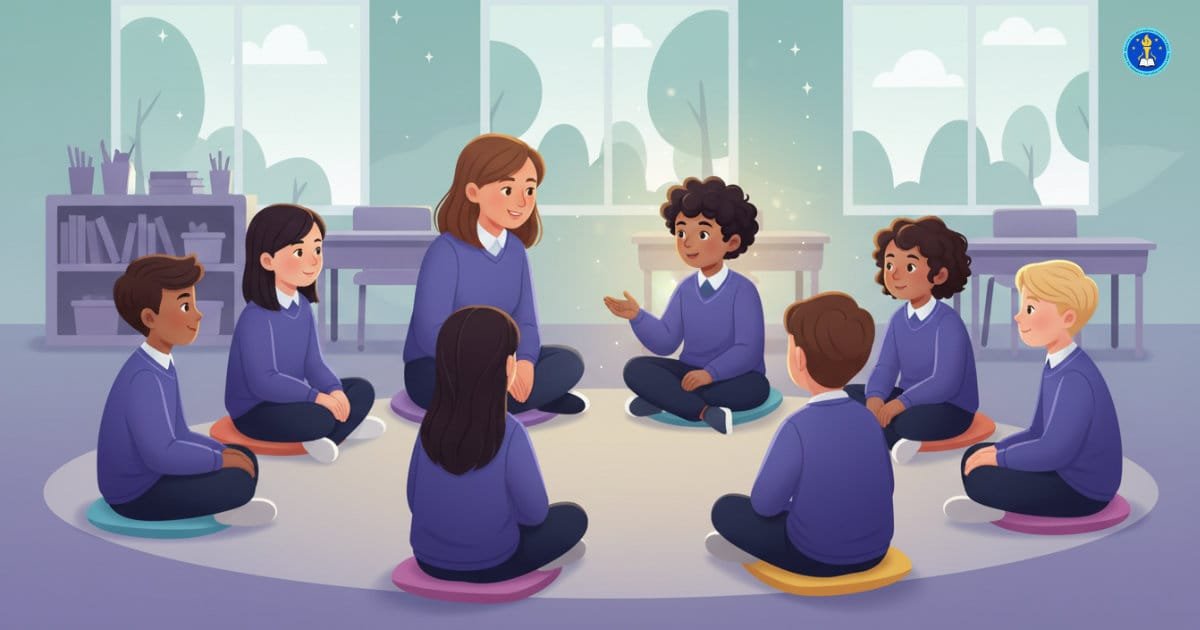
If you walked into Room 4 last Thursday morning, you might have thought the lesson had gone off track. The planned math activity sat untouched while Ms. Anjali crouched beside a group of students examining a spider web stretched between two chairs. “Why do you think it’s shaped like this?” she asked. “Does the pattern matter?” The children theorized – geometry, strength, spider vision. Twenty minutes later, they returned to fractions, but with questions about patterns and structure already activated in their minds.
This is what our tagline – “Learning That Listens” – actually means in practice. Not abandoning lesson plans randomly, but remaining responsive to how children learn best in specific moments, adapting teaching to meet students where they are rather than forcing them to conform to rigid predetermined sequences.
It Starts With Observation Before Instruction
Most mornings, teachers arrive thirty minutes before students. That time isn’t spent preparing materials primarily – it’s spent reviewing yesterday’s work, noting which children struggled with particular concepts, identifying patterns across multiple students that suggest the lesson moved too quickly or assumed knowledge students didn’t possess.
During Tuesday afternoon reflection sessions, teachers share these observations. “Five children in my class can’t distinguish between area and perimeter – they’re conflating the concepts.” Another teacher responds: “Same here. Let’s spend tomorrow using physical measurement of classroom objects before returning to abstract problems.” The planned lesson gets adjusted based on what students demonstrated they need, not what the textbook says comes next.
This responsiveness requires deep content knowledge. Teachers must understand mathematics well enough to recognize misconceptions instantly and adjust instruction on the spot. They must know literacy development thoroughly enough to diagnose why particular students struggle with specific reading skills. Surface-level knowledge allows only following scripted lessons; expertise enables responsive adaptation.
Recognizing That One Method Doesn’t Fit Everyone
In Ms. Priya’s kindergarten class, three children learn letter sounds through songs, five through physical movement activities tracing letters in sand, four through matching games, and six through reading picture books repeatedly. Same learning goal, multiple pathways depending on what engages each child effectively.
This differentiation happens constantly but invisibly to casual observers. During independent work time, some students use manipulatives for math while others work abstractly. Some children write rough drafts on paper; others dictate to teachers or use word processing. Some students need quiet corners for concentration; others work better with low background music or at tables with peers nearby.
Teachers track what works for whom through systematic observation and informal assessment. They notice that Sara comprehends better when she can move while listening, that Ahmed needs visual supports for multi-step instructions, that Fatima produces stronger writing when she can talk through ideas first. These observations shape how teachers present information and structure activities.
Pace Adjustments Happen Daily
Planned lessons include timing estimates, but teachers abandon those estimates immediately when students’ responses indicate different pacing is needed. If children grasp a concept quickly, teachers extend rather than simply moving to the next topic. If confusion is widespread, teachers slow down, reteach using different approaches, provide additional practice before advancing.
This flexibility frustrates parents sometimes when curriculum pacing doesn’t match expectations. “My child learned multiplication in Grade 2 at their previous school, but here it’s Grade 3.” Yes, because we don’t introduce operations until conceptual foundations are solid. We’d rather students understand deeply than memorize procedures they can’t explain. This requires patience with timing that prioritizes comprehension over coverage.
Questions Redirect Lessons in Real Time
During a Grade 4 lesson on water conservation, a student asked whether swimming pools waste water. Reasonable question, not directly related to the planned content about household consumption. The teacher didn’t dismiss it – “We’ll discuss that later” – but instead paused. “What do others think? How could we investigate this?” Fifteen minutes later, students had designed a comparison study of pool water use versus shower water use, incorporating measurement and calculation concepts initially planned for math later that week.
This kind of responsive teaching requires confidence. Teachers must trust that following student thinking produces learning even when it deviates from planned sequences. They must recognize that engagement matters more than coverage, that a question genuinely pursued teaches more than ten topics superficially addressed.
Not every student question becomes a lesson tangent, obviously. Teachers discern which questions open productive learning pathways and which are distractions. But the default response is curiosity rather than dismissal: “Interesting question – let’s explore that” rather than “Not now, we’re doing this.”
Feedback Shapes What Happens Next
Assessment in responsive classrooms happens continuously, not just during formal tests. Teachers circulate during independent work, noting who’s struggling, who’s finished early, who’s using unexpected but valid approaches. This information shapes tomorrow’s instruction.
If most students demonstrate mastery, the next lesson advances. If several struggle with the same concept, the next lesson reteaches that concept differently – using manipulatives if the first approach was abstract, using real-world examples if the first approach was theoretical, using peer teaching if the first approach was teacher-directed. The cycle continues until understanding emerges.
For students working significantly above or below grade level, teachers provide differentiated materials and expectations. Advanced students receive extension tasks requiring deeper thinking rather than simply more of the same work. Struggling students receive scaffolded support breaking complex tasks into manageable steps. Both groups remain part of the classroom community while receiving instruction matched to their current capability.
Mistakes Become Teaching Opportunities
In rigid classrooms, wrong answers are corrected quickly and lessons proceed. In responsive classrooms, wrong answers are examined. “Can you explain your thinking? What led you to that answer?” Often, mistakes reveal logical reasoning based on incomplete information or misconceptions worth addressing explicitly.
A child who calculates 15 – 8 as 13 (subtracting the smaller digit from the larger in each place value position) is applying a pattern they’ve noticed but overgeneralized. Telling them “No, it’s 7” doesn’t address the underlying misconception. Exploring why their method doesn’t work and demonstrating correct subtraction with regrouping does.
This approach takes longer than simply correcting and moving forward. It’s also more effective. Students learn that mistakes aren’t failures requiring shame but rather information helping teachers teach better and students learn more accurately.
The Physical Environment Adapts
Classrooms at our school don’t look identical despite shared values and approaches. Each teacher organizes space based on their students’ needs and their own teaching style. Some classes have tables arranged in clusters for collaborative work; others have rows allowing individual focus with collaboration happening in designated areas. Both arrangements work – what matters is matching setup to how students in that specific class learn best.
Similarly, materials available vary. A class with several children who process through movement has fidget tools and standing desk options. A class with students who need quiet has additional sound-dampening features. Teachers observe what their particular students need and adjust accordingly rather than maintaining uniform environments that supposedly serve everyone equally but actually serve no one optimally.
When Standard Approaches Don’t Work
Sometimes despite best efforts, a student isn’t progressing using typical instructional methods. This is when “learning that listens” matters most. Instead of continuing the same approach more intensively, teachers stop and ask: what’s preventing this child from learning this concept?
Maybe the student has undiagnosed vision problems affecting reading. Maybe they’re experiencing stress at home that’s consuming cognitive resources needed for academic focus. Maybe they need prerequisite skills not yet mastered. Maybe the teaching method simply doesn’t match how their brain processes information.
Teachers investigate systematically – testing different approaches, consulting with colleagues, involving parents, seeking specialist input when needed. The question isn’t “Why won’t this child learn?” but rather “What does this child need in order to learn?” That subtle shift in framing changes everything.
What This Requires From Teachers
Responsive teaching is more demanding than scripted instruction. Teachers must deeply understand content, recognize learning patterns, adapt quickly, tolerate ambiguity, make hundreds of instructional decisions daily based on student responses rather than following predetermined plans.
This is why we invest heavily in teacher collaboration and professional development. Teachers need time to reflect on what’s working, share strategies with colleagues, learn new approaches when current methods aren’t effective. Tuesday and Thursday afternoon reflection sessions aren’t optional luxuries – they’re essential infrastructure supporting responsive teaching.
It’s also why we maintain small class sizes. In a class of thirty-five, responsive teaching becomes nearly impossible – there’s insufficient time to observe each child carefully, diagnose individual needs, adapt instruction accordingly. With twenty students maximum, teachers can actually know each child’s learning patterns well enough to teach responsively rather than generically.
What Parents Notice
Parents sometimes find responsive teaching disorienting initially if they’re accustomed to more standardized approaches. Homework might differ across students. Lessons might not follow textbook chapter sequences. Progress might not match rigid timelines.
What parents eventually notice, though, is that their child enjoys learning, asks questions at home, demonstrates genuine understanding rather than rote recall, develops confidence as a learner rather than anxiety about school. These outcomes matter more than whether everyone in Grade 3 studies multiplication in March.
They also notice that teachers know their child specifically – not just as “a Grade 4 student” but as Sara who thinks visually and needs movement breaks, or Ahmed who processes slowly but arrives at sophisticated understanding eventually. This personal knowledge shapes daily interactions in ways generic teaching approaches can’t replicate.
The Philosophy Behind the Practice
Our founding principle – “If a child isn’t learning the way you’re teaching, teach the way the child learns” – sounds simple but implementing it requires systemic commitment. It requires hiring teachers who view their role as facilitating learning rather than delivering content. It requires providing time for reflection and collaboration. It requires accepting that learning looks different across children and that difference is normal, not problematic.
It also requires trusting that responsiveness produces better long-term outcomes than rigid adherence to scope and sequence charts, even when short-term progress looks uneven. A child who masters fewer topics but understands them deeply is better prepared for future learning than a child who’s been exposed to more content superficially.
“Learning that listens” isn’t a marketing slogan we invented to sound progressive. It’s a daily practice shaping every instructional decision – from how lessons are planned to how questions are answered to how mistakes are handled to how success is measured. It’s what distinguishes teaching from mere information delivery. And it’s what makes the difference between children who can perform in school and children who actually love learning.