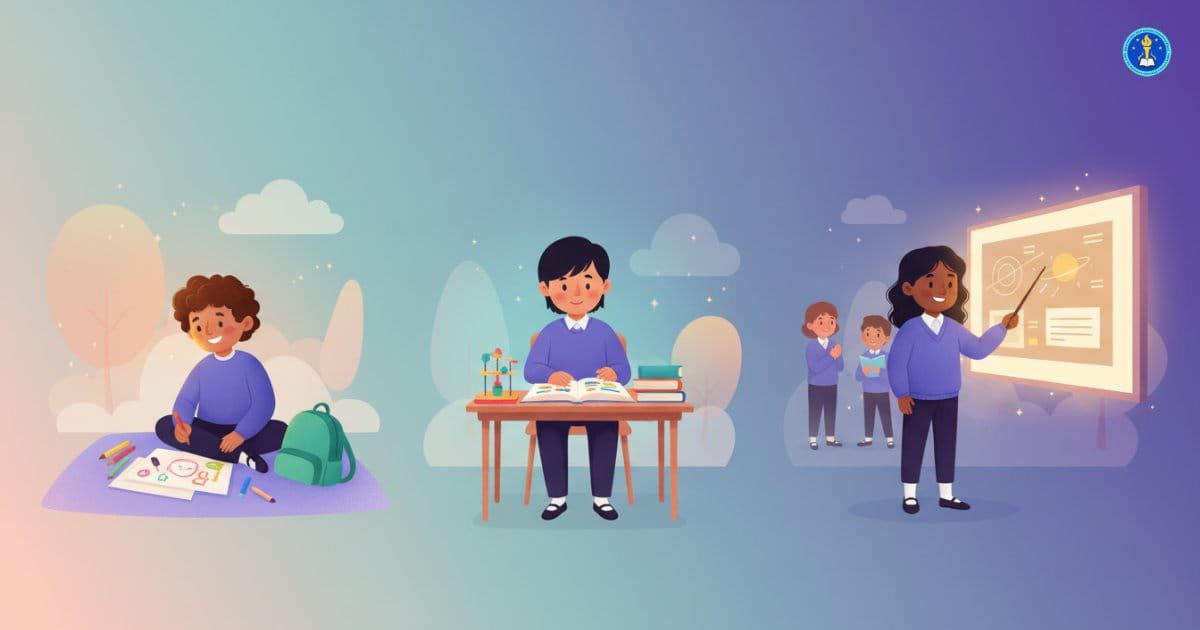
Imagine you could watch a child’s learning journey in time-lapse: a hesitant five-year-old gripping a pencil awkwardly transforms into an eleven-year-old writing paragraphs with confidence, debating ideas with peers, solving multi-step problems independently. The transformation seems almost magical – except it isn’t magic at all. It’s the result of carefully sequenced learning that builds complexity gradually, matching each stage to the child’s developing capabilities.
Parents often ask what children actually learn across these years, what progression looks like from kindergarten through Grade 6. The answer isn’t simply a list of facts acquired but rather a story of how thinking itself becomes more sophisticated as children mature. Understanding this progression helps parents support learning at home and appreciate why schools teach certain concepts at particular ages.
Kindergarten: Building the Foundation
Kindergarten looks deceptively simple – children play with blocks, listen to stories, practice writing letters. But within these activities, essential learning foundations are being established.
At age five, children develop phonological awareness – understanding that words break into sounds, sounds combine into words. They learn letter recognition and begin connecting sounds to symbols. They’re not yet reading fluently, but they’re building the neural pathways reading requires. Rushing this process produces frustration; respecting developmental timing produces confident readers eventually.
Mathematics in kindergarten focuses on number sense rather than computation. Children learn that numbers represent quantities, that five objects remain five whether arranged in a line or scattered, that patterns exist in sequences. They count, compare, sort, and begin recognizing that mathematics describes the world around them. Formal addition comes later; first comes intuitive understanding of more, less, same.
Perhaps most critically, kindergarten teaches how school itself works – sitting attentively during lessons, following multi-step instructions, sharing materials, asking for help appropriately, managing emotions when frustrated. These aren’t peripheral skills; they’re foundational to all future learning. A child who can’t yet regulate emotions or focus attention struggles academically regardless of intellectual capability.
Grades 1-2: From Concrete to Symbolic
In early primary years, learning becomes more formal but remains grounded in concrete experiences. Children transition from manipulating physical objects to working with symbols that represent those objects.
Reading shifts from decoding individual words to reading connected text fluently. By Grade 2, most children read simple chapter books independently. Comprehension becomes the focus – not just what words say, but what they mean. Children learn to make predictions, identify main ideas, connect stories to their own experiences. They begin distinguishing fiction from nonfiction and understanding that different texts serve different purposes.
Writing progresses from single sentences to short paragraphs. Children learn that writing communicates ideas to readers who aren’t present, requiring clarity that conversation doesn’t need. They practice sequencing thoughts logically, using punctuation to guide readers, choosing words precisely. Spelling conventions gradually replace inventive spelling as children internalize language patterns.
In mathematics, formal operations are introduced but always connected to concrete understanding first. Addition and subtraction make sense because children have physically combined and separated objects repeatedly. They learn that 5 + 3 = 8 isn’t magic but rather a symbolic representation of combining five things with three more things. Multiplication emerges as repeated addition; division as sharing equally. Each abstract concept builds on concrete foundation.
Grades 3-4: Developing Independence and Complexity
Middle elementary grades mark significant transitions. Children become more independent learners, capable of sustained focus and multi-step thinking without constant adult guidance.
Reading comprehension deepens substantially. Children analyze character motivation, identify themes, compare different texts on similar topics. They learn to question what they read, evaluate author credibility, recognize persuasive techniques. Critical thinking skills that begin with simple stories prepare them for analyzing complex texts later.
Writing becomes more sophisticated structurally. Children learn paragraph organization – topic sentences, supporting details, conclusions. They write across purposes: narratives tell stories, informational texts explain concepts, opinion pieces argue positions. They learn that good writing requires revision, that first drafts rarely communicate perfectly, that rewriting improves clarity.
Mathematics introduces fractions, decimals, and multi-digit multiplication and division. These concepts challenge many children because they require understanding part-whole relationships and place value deeply. Teachers use visual models extensively – fraction bars, decimal grids – connecting abstract notation to concrete representation. Word problems become more complex, requiring children to identify relevant information, choose appropriate operations, check answers for reasonableness.
Science and social studies expand beyond immediate experience. Children study ecosystems, ancient civilizations, geographic patterns – topics requiring abstract thinking about places and times they haven’t experienced directly. They learn to use maps, timelines, diagrams as tools for understanding complex information. Research skills emerge: finding information, evaluating sources, synthesizing across multiple texts.
Grades 5-6: Preparing for Secondary School
Upper elementary grades bridge childhood and adolescence academically. Learning becomes more abstract, assignments more extended, expectations for independence higher.
Reading now includes analyzing literary techniques – how authors use language to create effects, how perspective shapes narrative, how historical context influences texts. Children read increasingly complex materials and are expected to make sophisticated inferences, support interpretations with textual evidence, compare themes across works. They’re preparing for the analytical reading secondary school requires.
Writing assignments become more demanding. Children write multi-paragraph essays requiring thesis statements, organized arguments, synthesized evidence from multiple sources. They learn formal research processes: developing questions, locating relevant information, citing sources appropriately. Peer review becomes more structured – children learn to give and receive constructive feedback, understanding that revision strengthens work.
Mathematics includes ratios, percentages, negative numbers, algebraic thinking. These concepts require flexible thinking about quantities – that numbers can represent relationships rather than just amounts, that patterns can be generalized into formulas, that problems often have multiple solution pathways. Pre-algebra concepts appear, preparing students for formal algebra in secondary school.
Science becomes more experimental. Children design investigations, control variables, analyze data, draw evidence-based conclusions. They learn that science is a process of questioning and testing rather than simply memorizing facts. Social studies addresses more complex historical and geographic concepts, requiring students to analyze causes and effects, evaluate multiple perspectives, understand systemic patterns rather than just isolated events.
The Invisible Growth: Executive Function and Metacognition
Beyond subject content, these years develop thinking about thinking – metacognition – and self-management skills collectively called executive function. These capabilities matter as much as academic content, perhaps more.
Young children need external structure constantly. Teachers and parents organize their materials, remind them of tasks, break assignments into manageable steps. By Grade 6, students increasingly manage these functions independently – they track assignments in planners, recognize when they need help, allocate time across multiple tasks, monitor their own comprehension while reading.
This progression isn’t automatic; it requires explicit teaching and repeated practice. Schools scaffold executive function development deliberately, gradually releasing responsibility from adults to students. A Grade 2 teacher might pack children’s backpacks with them daily; a Grade 5 teacher expects students to manage this independently but teaches organizational systems supporting independence.
Social and Emotional Development Alongside Academics
Cognitive growth happens alongside social-emotional maturation, and each domain influences the other. Children can’t focus on academics when emotionally dysregulated, and academic success builds confidence that supports emotional wellbeing.
Kindergarteners are learning to share, wait their turn, handle disappointment when activities end. By Grade 3, they’re navigating more complex peer relationships – forming friendships based on shared interests rather than just proximity, managing conflicts through words rather than physical reactions, understanding that different friends meet different needs.
By Grade 6, students are developing identity beyond family – they’re beginning to define themselves through interests, abilities, values. They’re more aware of peer comparison and social hierarchies, which can create anxiety but also motivates growth. Schools supporting healthy social-emotional development help students channel this self-awareness productively rather than letting it become destructive comparison.
Why Age-Appropriate Teaching Matters
Sometimes parents want to accelerate learning – teaching kindergarteners multiplication, assigning Grade 3 students high school novels. While well-intentioned, this often backfires. Children taught concepts before they’re developmentally ready typically memorize procedures without understanding, creating gaps that cause problems later.
Conversely, holding children to earlier expectations when they’re ready for more complex thinking breeds boredom and disengagement. The goal isn’t teaching as much as possible as early as possible, nor is it allowing children to coast without challenge. It’s matching instruction to developmental readiness – a moving target requiring constant teacher assessment and adjustment.
This is why professional educators invest years learning developmental psychology, instructional progression, and assessment. Teaching isn’t simply knowing subject matter; it’s understanding how minds develop capability over time and structuring learning to honor that progression.
What Parents Should Expect at Each Stage
Understanding general developmental trajectories helps parents support learning appropriately without over-helping or under-supporting.
In kindergarten through Grade 2, expect learning to look playful – hands-on activities, movement, stories, art integrated with academics. This isn’t entertainment; it’s age-appropriate pedagogy. Also expect variability – some children read fluently in Grade 1, others not until Grade 2, and both timelines are normal.
In Grades 3-4, expect increasing homework and independence expectations. Children should manage most tasks with minimal parental involvement, though they still need structure and checking. Expect that understanding doesn’t always come quickly – fractions and multiplication tables require time and practice for most children.
In Grades 5-6, expect children to take primary responsibility for their learning. Parents provide environment and support, but students drive their own academic work increasingly. Expect occasional struggles – learning involves productive failure, and shielding children from all difficulty prevents growth.
Across all grades, expect that learning isn’t linear. Children progress, plateau, even regress temporarily before advancing again. Development spirals rather than climbs a straight ladder. Patience during plateaus matters as much as celebration during breakthroughs.
The Journey’s Arc
From kindergarten to Grade 6, children transform from dependent learners requiring constant guidance to increasingly independent thinkers capable of managing complex tasks with decreasing adult direction. They move from concrete thinking grounded in immediate experience to abstract reasoning about concepts they’ve never directly encountered. They develop from egocentric perspectives focused primarily on their own experience to more sophisticated understanding of others’ viewpoints and complex systems.
This transformation happens gradually through thousands of lessons, each building on previous learning, each stretching capability slightly beyond current comfort. There are no shortcuts. Trying to force faster progress typically creates anxiety and gaps; respecting developmental timing while maintaining appropriate challenge produces confident, capable learners prepared for whatever comes next.
That’s the goal – not racing through content, but building thinkers who can continue learning independently long after they leave elementary school. The specific facts they learn matter less than the thinking skills and learning habits they develop. Those capabilities will serve them across their lives, adapting to contexts we can’t yet imagine.