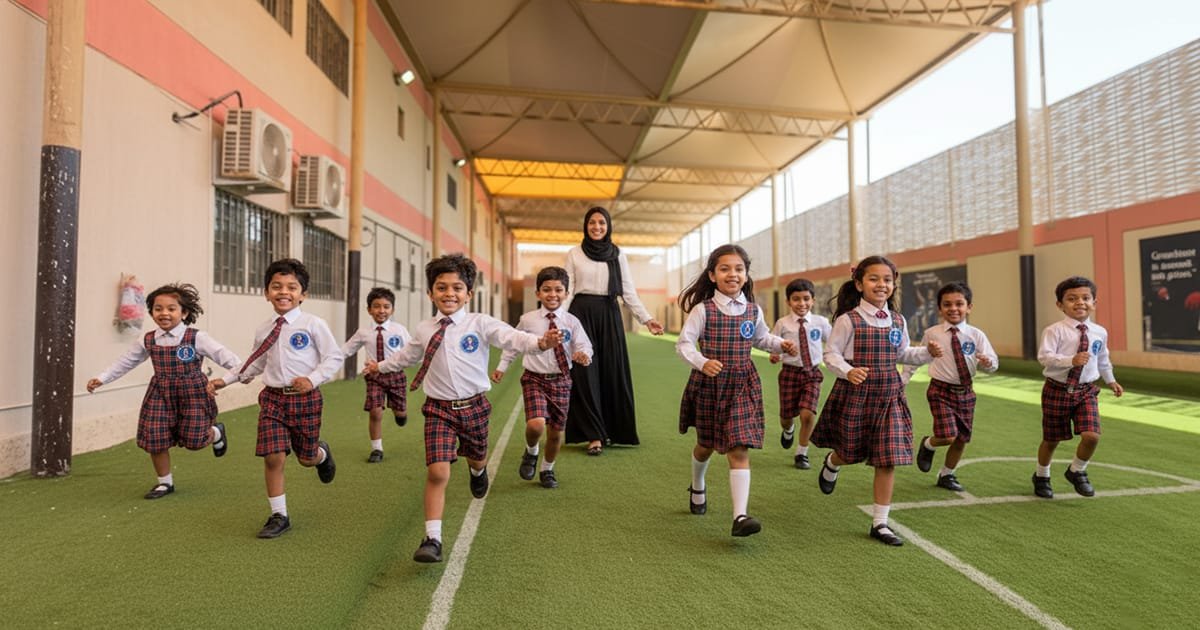

What does a good school actually look like? Not in brochures or on websites, but when you walk through the doors on a Tuesday morning unannounced?
Every January, dozens of families visit our campus during admissions season. Some arrive with checklists of features they’ve researched online. Others come uncertain what they’re even looking for beyond a vague sense of “quality.” After three decades in education, I’ve learned that the most revealing indicators of school quality aren’t the obvious ones parents typically notice first.
Look at What’s Happening, Not What’s Displayed
Many schools present beautifully curated displays – student work arranged artistically on walls, colorful bulletin boards announcing themes, achievement certificates prominently featured. These look impressive but reveal little about daily educational reality.
Instead, watch what students are actually doing during your visit. Are children engaged in their tasks, or are they staring blankly waiting for instructions? Do you see collaboration and conversation, or silent rows working individually? Are students asking questions, or only answering them when prompted?
If possible, observe a classroom during a lesson. You’re not evaluating the teacher’s performance – you’re watching student behavior. Do children seem comfortable raising hands? When someone gives a wrong answer, do peers laugh or does the teacher handle it matter-of-factly? Do students help each other, or is assistance only teacher-directed?
These observations reveal culture more accurately than any mission statement. A school can claim to value curiosity, but if classrooms show children sitting passively while teachers lecture without pause, the claim rings hollow. Culture lives in daily practice, not posted values.
Listen to How Adults Talk to Children
During your campus tour, you’ll encounter teachers and staff interacting with students. Pay attention to tone and language, not just what’s said but how it’s delivered.
Do adults speak to children respectfully, or do they use condescending tones that suggest children are lesser beings? When redirecting behavior, do they explain expectations or simply issue commands? Do they greet students by name, or treat them as an undifferentiated group?
Listen for positive specificity rather than generic praise. “I noticed you helped Sarah find her pencil – that was thoughtful” teaches more than “Good job!” The former identifies specific behavior worth repeating; the latter is automated pleasantry that children learn to ignore.
Also notice how adults respond when children interrupt or ask questions during your tour. Do they dismiss the child quickly to refocus on you, or do they acknowledge the child first before returning attention to the tour? This seemingly small choice reveals whether adult priorities genuinely center children or whether children are stage props in a performance for prospective parents.
Physical Environment Signals Priorities
Infrastructure matters, but not primarily for aesthetic reasons. The physical environment reveals what the school actually prioritizes versus what it claims to prioritize.
Look at classroom libraries. Are books accessible to children at their height, or stored high where only adults can reach them? Are books organized in ways children can navigate independently, or is the system so complex that constant adult assistance is required? The former suggests genuine interest in student independence; the latter suggests books are decorative rather than functional.
Examine displayed student work carefully. Is every piece perfect, suggesting teachers heavily edited or that only flawless work gets recognition? Or do displays include works-in-progress, rough drafts with teacher feedback, examples showing learning processes rather than just polished outcomes? Schools genuinely valuing learning process over performance product will display evidence of both.
Check bathroom facilities – this sounds trivial but matters significantly. Are bathrooms clean and stocked with supplies? Are they located conveniently, or must children navigate long distances? Are they age-appropriate in terms of fixtures and privacy? Daily dignity matters for children’s comfort and health.
Notice whether outdoor play space exists and appears regularly used. Are there sports equipment, shaded areas, varied terrain offering different play opportunities? Or is “outdoor time” a barren yard with nothing to do? Children need physical movement and unstructured social time. Schools treating this as afterthought rather than essential reveal misunderstanding of child development.
Ask Questions That Reveal Reality, Not Ideals
Most schools can articulate educational philosophy eloquently. What matters is whether philosophy actually shapes practice. Your questions should probe for specifics rather than accepting abstract reassurances.
Instead of “Do you have small class sizes?” ask “What’s your maximum student-teacher ratio, and how do you verify you maintain it?” Instead of “Do you offer individualized instruction?” ask “Can you give me an example of how a teacher adapted a recent lesson for a struggling student?” Instead of “Is bullying addressed?” ask “Walk me through what happens when a child reports being excluded at recess – who’s involved, what timeline, how are parents informed?”
Specific questions force specific answers. Vague questions invite vague reassurances that sound good but commit to nothing verifiable. If school leadership can’t provide concrete examples of their stated approaches, either they’re new and haven’t implemented yet, or the approaches exist in policy documents but not in daily practice.
Ask about challenges too. “What’s the hardest aspect of maintaining your educational approach?” or “What would you change about the school if resources weren’t a constraint?” Honest answers to these questions reveal self-awareness and realistic assessment of current state. Overly polished responses suggesting everything is perfect indicate either dishonesty or lack of critical reflection – neither inspires confidence.
Observe Teacher Collaboration and Professional Culture
You’re unlikely to observe teacher meetings during a campus tour, but you can ask about professional development and collaboration structures. Schools investing in teacher growth produce better student outcomes than schools treating teachers as interchangeable deliverers of scripted curriculum.
Ask: “How often do teachers meet to discuss student progress?” “What professional development opportunities exist?” “How do you support new teachers learning your approach?” The answers reveal whether teaching is treated as isolated individual work or as collaborative professional practice.
If possible, observe teacher workspaces or staff areas briefly. Do teachers have dedicated planning time and space, or are they constantly in student-facing mode with no room for preparation or collaboration? Teachers need time to plan, reflect, and coordinate. Schools that provide this produce better instruction than schools maximizing every minute of adult time for direct student contact without supporting the professional work teaching requires.
What Leadership Reveals During Your Visit
Meeting with school leadership during your visit tells you about accessibility and priorities. Is the principal available to meet prospective families, or are visits handled entirely by admissions staff? Neither option is inherently wrong, but they signal different leadership styles.
If you meet leadership, notice whether they speak primarily about academics or also address social-emotional development, character formation, and community building. Schools reducing education to test scores alone miss significant portions of child development. Balanced attention to multiple facets suggests more comprehensive understanding of what children need.
Also observe how leadership discusses challenges. Do they acknowledge areas needing improvement, or present everything as already excellent? Leaders willing to identify growth edges demonstrate intellectual honesty and commitment to continuous improvement. Leaders presenting perfection reveal either dishonesty or lack of critical self-assessment.
The Campus Tour Red Flags
Certain observations during campus visits should concern you regardless of how appealing other aspects seem.
If every classroom looks identical – same arrangement, same displays, same activities – it suggests teachers lack autonomy to adapt instruction to student needs or their own teaching strengths. Standardization can indicate quality control, but excessive uniformity suggests scripted instruction that may not respond to individual learners.
If you don’t see students of varying ability levels engaged appropriately – if some children sit idle while others work, or if every child does identical tasks regardless of readiness – it suggests lack of differentiation. Effective schools provide instruction matching each child’s current capability and challenging them appropriately.
If leadership can’t articulate clear discipline policies or becomes defensive when asked about behavior management, it suggests either unclear expectations or unwillingness to discuss difficult realities honestly. You need to understand how the school handles conflicts, behavioral challenges, and peer issues because these will arise regardless of how positive the environment generally is.
If staff seems rushed, stressed, or speaks negatively about students or families even subtly, pay attention. Teachers under chronic stress cannot provide the patient, responsive teaching children need. Negative attitudes toward students or families poison school culture regardless of curriculum quality.
Trust Your Instincts and Your Child’s Response
After gathering observable data, pay attention to less tangible impressions. Does the environment feel welcoming or sterile? Do you hear laughter and conversation, or oppressive quiet? Would you personally want to spend six hours daily in these spaces?
If you bring your child during the visit, watch their reactions carefully. Do they seem curious and interested, or anxious and withdrawn? Children often sense emotional atmosphere more accurately than adults who focus on explicit features. A child who feels immediately comfortable in a space is responding to cues we might not consciously notice but that matter significantly.
That said, don’t over-interpret single reactions. A shy child might feel uncomfortable during any campus tour regardless of school quality. An outgoing child might enjoy any tour because new environments excite them. Look for patterns across multiple observations rather than relying solely on one moment’s impression.
What Matters Most Cannot Be Observed in One Visit
Campus visits provide valuable information, but they’re snapshots of complex ongoing realities. You cannot fully assess school quality from a single tour any more than you could evaluate a person’s character from one conversation.
Ask to speak with current parents if possible. Their experiences over months or years reveal more than polished presentations. What do they appreciate most? What frustrates them? How does the school handle problems when they arise? Would they choose this school again knowing what they know now?
If the school is new and lacks current parent testimonials, understand you’re taking a larger risk – you’re betting on leadership competence and stated intentions rather than demonstrated track record. That’s not necessarily wrong, but acknowledge it consciously rather than treating a founding year school as equivalent to one with established history.
Ultimately, no school is perfect. You’re looking for good-enough quality combined with values alignment and practical factors like location and affordability. The goal isn’t finding an ideal fantasy school but rather identifying where your specific child can thrive given real-world constraints and your family’s circumstances.
Walk through with eyes open, ask specific questions, observe carefully, and trust that you can discern genuine quality from polished performance. Your child’s education matters too much to choose based solely on impressive brochures or convenient location. But with careful observation and thoughtful questioning, campus visits reveal the truth underneath the surface presentation. That truth is what you’re really choosing.