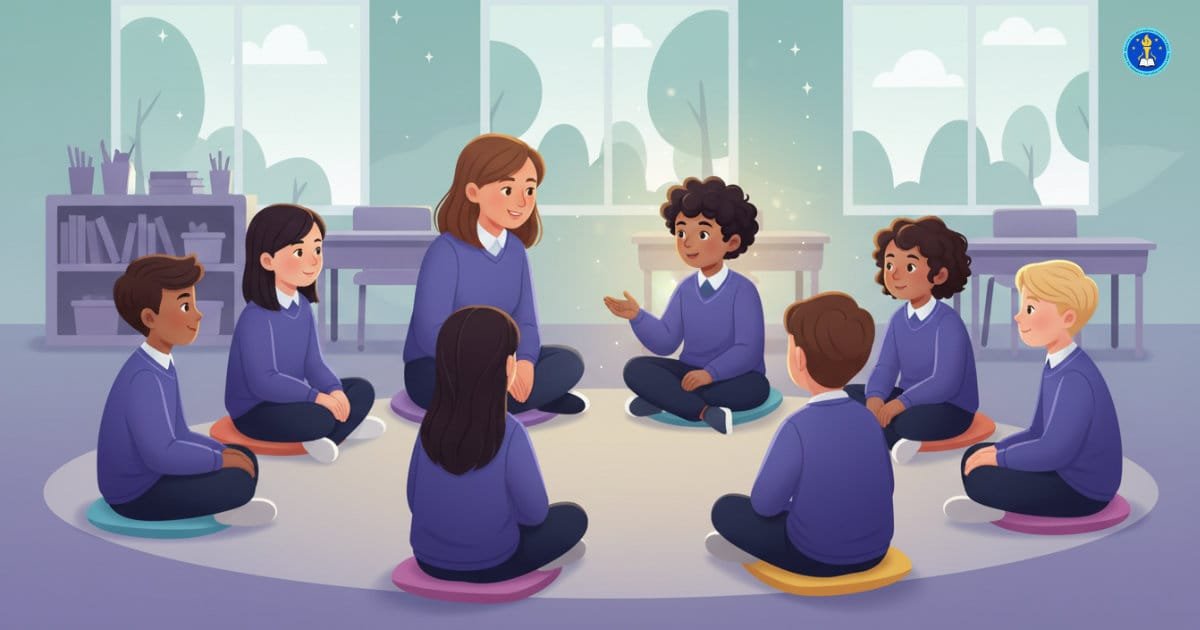
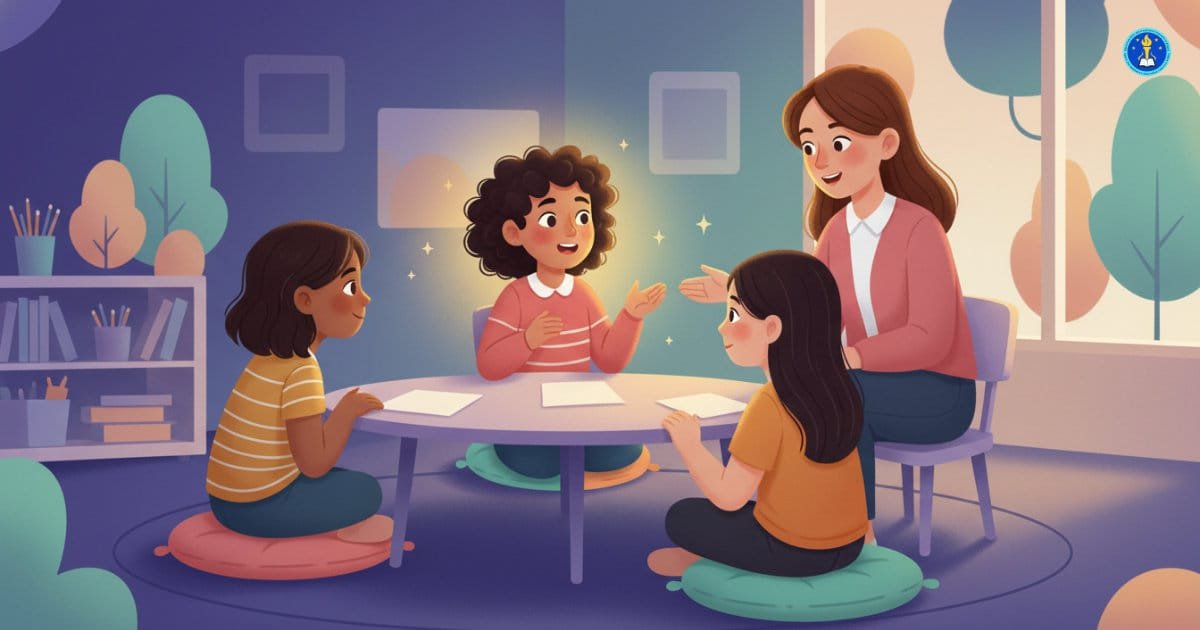
Yesterday, during circle time, I watched Layla whisper her answer to the girl sitting next to her instead of sharing with the class. Her classmate repeated it aloud – “Layla says it’s because the ice melted” – and Layla looked down at her hands, half-pleased her idea was heard, half-uncomfortable with the attention.
I see this often. Children who know the answers but won’t volunteer them. Students who participate eagerly in small groups but freeze when the whole class is watching. It’s easy to misread this as disinterest or lack of understanding when actually it’s something else entirely: a child who needs different conditions to feel safe speaking up.
Understanding Shyness Versus Social Anxiety
Not all quiet children are shy, and not all shy children need intervention. Some students are simply reflective – they think before speaking, prefer listening to talking, and process internally rather than aloud. This is temperament, not a problem requiring solutions.
Shyness becomes concerning when it prevents children from participating in ways they want to participate, when it creates visible distress in social situations, or when it limits their ability to show what they know. A child content observing from the sidelines differs from one who desperately wants to join but can’t overcome the fear of speaking.
We watch for signs that quiet behavior is distressing rather than simply reflective: physical tension when called on, tears or shutdown during group work, avoiding eye contact consistently, or parents reporting that the child talks extensively at home but barely at school. These suggest the child needs support building confidence in classroom contexts.
Creating Low-Pressure Speaking Opportunities
Forcing shy children to speak publicly before they’re ready typically backfires, increasing anxiety rather than building confidence. Instead, we create graduated opportunities starting with minimal risk and slowly expanding as comfort grows.
Partner work comes first. Shy children often speak easily one-on-one, where the audience is just one peer and the stakes feel lower. We pair them intentionally with patient, encouraging classmates who won’t dominate the conversation. These partnerships build confidence through successful small-scale interactions.
Small groups follow. A circle of four or five children discussing a question feels less exposed than addressing the entire class. The shy child might contribute just one comment initially, but that’s progress. We acknowledge participation without making it dramatic – a nod, eye contact, repeating their idea to validate it – which encourages without overwhelming.
Whole-class participation develops last, and even then we use strategies that reduce spotlight pressure. Think-pair-share activities let children rehearse ideas with a partner before possibly sharing with everyone. Choral responses allow joining collective answers without individual exposure. Written responses on whiteboards let children show thinking without verbal performance.
Predictability Reduces Anxiety
Unpredictability amplifies shyness. When children don’t know if they’ll be called on randomly, anxiety stays elevated constantly. Predictable structures let shy children prepare mentally for participation moments.
We might tell Layla privately, “During science today, I’ll ask you about your experiment. You don’t have to answer in front of everyone – you can tell me quietly and I’ll share for you, or you can share yourself. Your choice.” This removes surprise, gives control, and makes participation feel manageable rather than terrifying.
Routines help tremendously. If circle time always follows the same pattern – greeting, sharing, question of the day – shy children know what’s coming and can prepare. If sharing is optional and clearly marked as such, they don’t spend the entire circle dreading being forced to speak.
We also use wait time intentionally. After asking a question, we pause five to ten seconds before expecting responses. Shy children often need extra processing time, and rushing for immediate answers excludes them systematically. Longer pauses let more children formulate thoughts and build courage to respond.
Validating Ideas Without Spotlighting the Child
When a shy child finally speaks, our response matters enormously. Excessive praise creates pressure – now they must live up to being the “brave” one. Ignoring the contribution suggests it wasn’t valuable. The balance is acknowledging the idea without making the child the center of attention.
“That’s a helpful observation” works better than “I’m so proud you spoke up!” The former validates the content; the latter makes the act of speaking the focus, which increases self-consciousness. We want children thinking about what they said, not about the fact that they said something.
Sometimes we attribute ideas without naming children. “Someone noticed the pattern changes here” shares the thinking without spotlighting who said it. This lets shy children contribute intellectually while maintaining emotional safety. As confidence builds, they eventually want credit for their ideas, and we shift to naming them when they’re ready.
Building Confidence Through Mastery
Shyness often connects to uncertainty. Children hesitate speaking when they’re unsure if their answer is correct or if their idea makes sense. Building genuine competence reduces this uncertainty, making participation feel less risky.
We give shy children tasks they can successfully complete, then create low-pressure opportunities to share those successes. If Layla draws a detailed diagram during independent work, we might ask if we can show it to the class while she explains it just to us quietly. The work speaks for itself; she doesn’t have to perform verbally.
We also teach explicitly that uncertainty is acceptable. “I’m not completely sure, but I think…” becomes a sentence frame we model and encourage. This normalizes tentative participation, removing the expectation that every contribution must be perfectly correct. When children see adults and confident peers saying “I’m not sure,” they learn that participation doesn’t require absolute certainty.
When Home and School Look Different
Parents often tell me their child talks constantly at home – narrating every thought, asking endless questions, directing imaginative play aloud – yet barely speaks at school. This isn’t contradictory; it reflects that different environments activate different comfort levels.
Home is entirely safe. Everyone present loves the child unconditionally. Mistakes have no social cost. The audience is familiar and predictable. School contains more variables: peers who might judge, adults whose approval feels important, performance expectations, social comparison. Even confident children modulate behavior across contexts; shy children modulate more dramatically.
We ask parents to share what topics energize their child at home. If Layla talks extensively about animals, we might invite her to bring a book about her favorite animal and tell just the teacher about it initially, expanding the audience gradually. Connecting school participation to existing passions makes speaking feel less like performance and more like sharing something genuinely interesting.
Physical Positioning and Environmental Adjustments
Where a child sits influences their willingness to participate. Some shy children feel safer in back rows where fewer people look at them; others prefer front rows where they focus on the teacher rather than peers. We ask what feels comfortable rather than assuming.
For some children, sitting near a friend provides crucial support. Knowing someone safe is physically close reduces anxiety. For others, sitting near a friend increases performance pressure – they worry about what that friend thinks. Individual preferences vary, so we observe and adjust.
We also minimize unnecessary attention during vulnerable moments. If a shy child is presenting work, we might have the class look at the work itself displayed on screen rather than staring at the child. This redirects attention to ideas rather than the person delivering them.
Celebrating Progress, Not Personality Transformation
The goal isn’t transforming shy children into outgoing ones. Temperament is relatively stable, and shyness isn’t a deficit requiring correction. The goal is helping shy children participate in ways that work for them, so shyness doesn’t prevent them from showing what they know or connecting with peers.
A shy child who moves from never speaking to occasionally answering questions in small groups has made significant progress, even if they still don’t volunteer in whole-class discussions. That’s not failure; it’s growth. We celebrate expanding comfort zones rather than demanding personality change.
Some children will always prefer listening to talking, and that’s legitimate. The question is whether their quietness reflects preference or fear. If it’s preference, we honor it. If it’s fear preventing desired participation, we provide scaffolding until fear diminishes enough that choice becomes possible.
What Parents Can Do
At home, avoid labeling. “She’s just shy” becomes a fixed identity children internalize and live up to. “She takes time warming up to new situations” acknowledges the pattern without making it permanent. The difference matters – one suggests unchangeable personality, the other suggests a process that can evolve.
Practice low-stakes social interactions. Ordering at restaurants, asking store clerks where items are located, greeting neighbors – these build speaking-up muscles in contexts where mistakes don’t matter and audiences are strangers the child won’t see again. Success in low-risk situations transfers gradually to higher-stakes school contexts.
Role-play school situations at home. If your child struggles asking teachers for help, practice the exact words they might use. Rehearsal reduces the cognitive load during actual moments, making participation feel more automatic and less frightening. This isn’t forcing performance; it’s building a mental script that reduces uncertainty.
Validate feelings without reinforcing avoidance. “I understand talking in class feels scary” acknowledges the emotion. “And you don’t have to do things that feel scary” reinforces avoidance. Instead: “I understand it feels scary, and it’s also important to try. What’s one small way you could participate tomorrow?” This validates feeling while encouraging action.
Patience as Strategy
Building confidence in shy children requires patience measured in months, not days. A child who spoke zero words in September might contribute occasionally by January and regularly by May. That’s appropriate progress, not evidence that strategies aren’t working.
Pushing too fast typically causes regression. If a child forced to speak before ready shuts down completely, regaining trust takes longer than if we’d waited initially for readiness. Better to move slowly with consistent forward motion than to rush and create setbacks.
We also recognize that shy children often show dramatic growth between years. The same child who barely spoke in Grade 2 might surprise everyone with increased confidence in Grade 3. Developmental maturation contributes significantly – children gain self-assurance as they master academic content, develop friendships, and simply grow older. Our role is supporting them through the uncomfortable earlier stages until natural maturation helps.
What we don’t do is ignore shy children, assuming they’ll participate when ready without support. Left entirely alone, some children entrench in silence because avoidance feels safer than trying. Gentle, consistent invitations and low-pressure opportunities matter. The key is calibrating pressure correctly – enough invitation to encourage growth, not so much that fear increases.
Layla, the girl who whispered to her classmate during circle time? Three weeks later, she raised her hand and answered aloud for the first time. Her voice was quiet, and her eyes stayed on her desk, but she did it. That took courage we acknowledged privately afterward: “I noticed you shared today. That can feel hard, and you did it.” No grand celebration, no dramatic praise – just recognition that she took a risk and it went okay. Next time might come easier. Or it might not. Either way, we’ll keep creating space where she can find her voice at her own pace.